A Long Story is Coming to an End

(© Per Kasch | perkasch.com)(© Per Kasch | perkasch.com)

What 20 Years of Organizational Development Taught Me About Leadership, Ecosystems, and Trust

After more than 20 deeply fulfilling years in Organizational Development—shaped by countless meaningful encounters—I find myself consciously closing one chapter and carrying its core insights forward.

I am profoundly grateful to my outstanding team, our exceptional trainers, and more than 120 prestigious corporate clients who placed their trust in us over the years. Working with them shaped not only my professional path, but also my deep conviction about what truly drives sustainable success.

Throughout this journey, I was privileged to collaborate with some of the most influential thinkers in our field—most notably my mentor and dear friend Edgar H. Schein, as well as inspiring voices such as Amy Edmondson, Otto Scharmer, and Peter Senge. What unites their work is not a specific method, framework, or tool, but a shared respect for human relationships as the foundation of effective leadership.

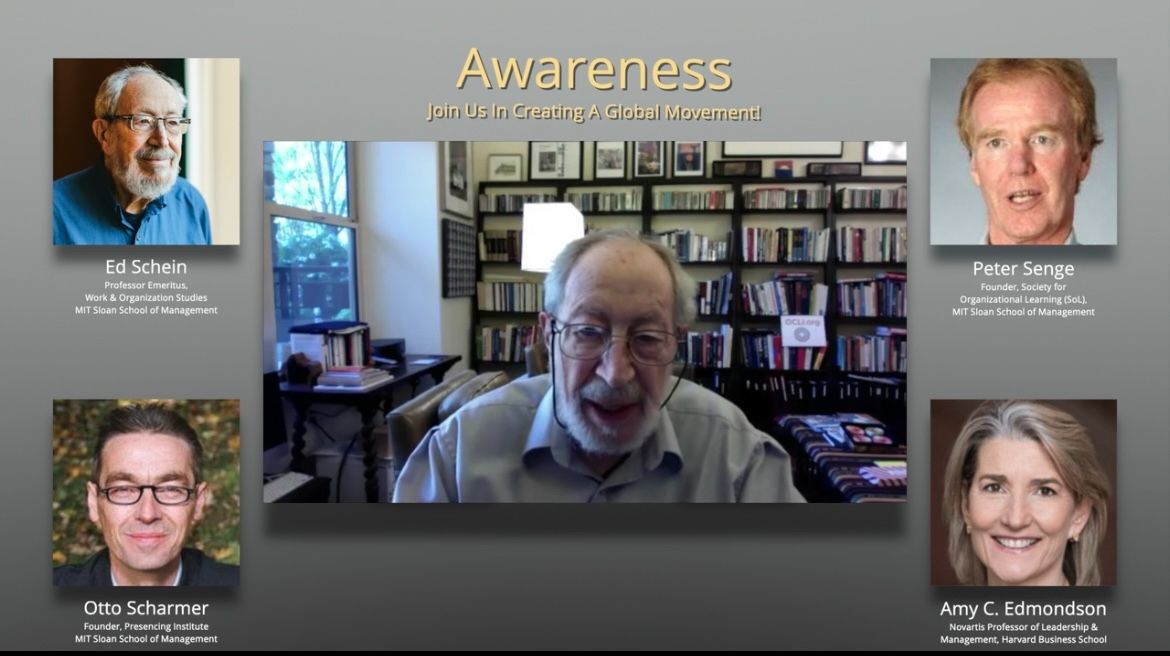
“Creating a Triple A Society through Reflection on Crisis and Change”: Video Sessions with Ed Schein, Amy C. Edmondson, Otto Scharmer, and Peter Senge, Spring 2021 (© G. Fatzer | M. Laederach | D. Schmid)

From Organizations to Ecosystems—The Real Leadership Challenge Ahead

As Peter Senge once emphasized in a joint session with Gerhard Fatzer, Dr. (Visiting faculty and Visiting Prof.), and Mouna Laederach, the decisive arena of the future will not be individual organizations or isolated leadership formats. It It will be the quality of ecosystems.

Markets, clients, partners, and internal stakeholders are becoming ever more interconnected. In this reality, the central leadership challenge is no longer efficiency alone, but the ability to hold the productive tension between competition and collaboration.

Organizations that master this tension are those that invest deliberately in relationships—across boundaries, roles, and institutional logics. The quality of these ecosystems will determine who thrives in the long run:

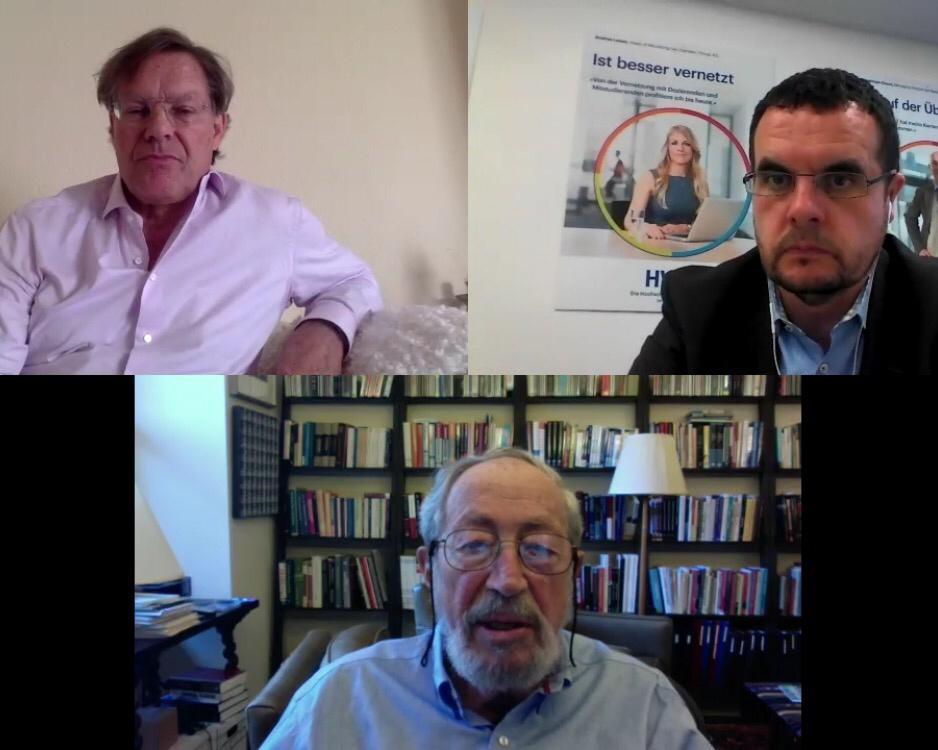
Peter Senge, Video Session, 13/03/2021 (© G. Fatzer | M. Laederach | D. Schmid)

Leadership Remains Relational—Especially in the Age of AI

In Humble Leadership (2nd edition, 2023), Edgar Schein and his son Peter Schein articulate a principle that has guided my own work for decades: complex challenges cannot be solved through authority or expertise alone. They require openness, trust, and genuine curiosity.

Leaders achieve better outcomes when they acknowledge what they do not know, ask honest questions, and listen attentively—thereby unlocking the collective intelligence of the system. Recognized as the number one management thinker in the world for two consecutive years, Amy C. Edmondson captures this insight succinctly in Right Kind of Wrong (2023):

«A system’s results are less shaped by its individual parts than by how the parts relate to one another.» (Amy C. Edmondson)

This is not a «soft» idea. It is a strategic one.

We are entering an era in which artificial intelligence will dramatically optimize processes, decisions, and information flows. Precisely because of this technological acceleration, human connection becomes more—not less—decisive. AI can enhance systems, but only people create meaning, trust, and commitment. Leadership effectiveness, customer loyalty, and long-term business success will therefore depend on the quality of relationships leaders are able to build and sustain.

In his final message, shared by Otto Scharmer in January 2023, Edgar Schein expressed this truth with characteristic clarity—reminding us that progress without relationship ultimately remains hollow:
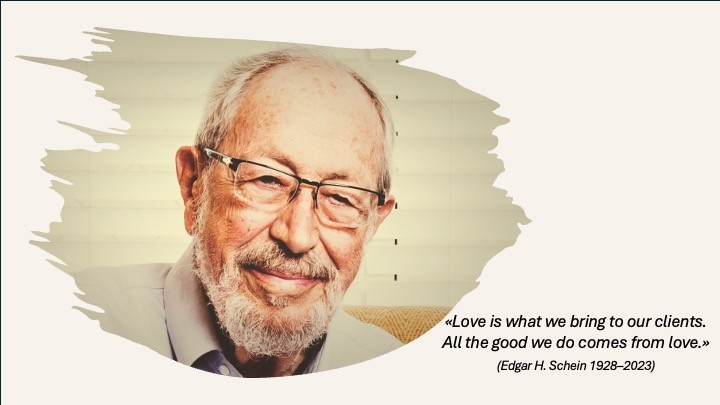
«Love is what we bring to our clients. All the good we do comes from love.» (Edgar H. Schein)

What I Stand For Going Forward

Looking back, there is little to add and much to affirm. What I carry forward from these years is a clear position: sustainable success is never primarily a question of tools, models, or technologies. It is a question of relationship quality—between leaders and teams, organizations and customers, and increasingly, between organizations themselves. This is the principle I continue to stand for. It is the lens through which I approach leadership, collaboration, and long-term customer relationships.

Thank you to everyone who has been part of this journey. It has truly been a pleasure—and it is far from over. The path ahead is guided by a simple conviction: leadership begins with human connection, and organizational success will be shaped by the quality of our relationships. My next learning page will be written soon, so stay tuned: «The Future is analogue!»

Daniel C. Schmid, January 1st, 2026

Working with Ed Schein

Together with Prof. Gerhard Fatzer, PhD, Trias Institute, I had the honor and great pleasure of working for several years with Prof. Edgar H. Schein, Emeritus MIT Sloan School of Management (1928–2023), one of the co-founders of organizational development. On the one hand, I was able to learn a great deal about the fascinating facets of organizational development directly from the spiritus rector of the discipline, and on the other, I was able to catch up on Ed’s exciting family history (see my HWZ/Trias conference keynote in 2017, Learning Journey to Trstena). I have thus succeeded in tracing the history of his ancestors in Trsztena in Upper Hungary and Trstena in Czechoslovakia in detail (see my article A Learning Journey to Trstená According to Edgar H. Schein’s «Organizational Culture Model»). I felt overwhelmed and honored by how Ed had evaluated my research:

«Daniel Schmid has opened up an important new research field—historical ethnography—in tracking down some of my family origins in communities that deliberately hid them because of fears of the Nazi anti-semitism. This was not only of great value to me but revealed some historical details of how a powerful evil ideology can be so threatening that it not only kills existing people but scares communities into wiping out the identities of former residents. This research is an important contribution to both social psychology and political science because we see similar uses of fear mongering in today’s autocratic leaders.» (Edgar H. Schein, 05.03.1928 – 26.01.2023)

Our fruitful cooperation with Ed lasted until 2023 and produced several significant scientific contributions to organizational development, including books, video statements and timeless ideas that Gerhard Fatzer and myself would like to share with you:

From start-ups to mature organizations, all teams and organizations need cultural work. In the age of globalization and digital competition, unprejudiced leadership and cultural development are therefore of central importance. As friends from the circle of Ed Schein, we encourage an international dialogue on the «Art of Change» in the age of digitalization and bring together German and American approaches. The precise descriptions of the fundamentals of sustainable organizational development can be used directly in projects and transformation processes. Here are our results, please help us to preserve Ed Schein’s work for future generations:

2024: Gerhard Fatzer / Anne Fanenbruck (Ed.): Organisationsentwicklung als Kunst. Veränderung durch Dialog und vorurteilslose Führung. Hommage an Edgar H. Schein [Organizational Development as an Art. Change through Dialogue and unprejudiced Leadership. Homage to Edgar H. Schein], Psychosozial-Verlag, Giessen 2024.

2021: Gerhard Fatzer / Daniel C. Schmid (Ed.): Kunst der Veränderung. Vorurteilslose Führung und Organisationsentwicklung [The Art of Change. Humble Leadership and Organizational Development], Psychosozial-Verlag, Giessen 2021.

2020: A Manifesto of the Pioneers of Change, together with Edgar H. Schein, Amy C. EdmondsonC. Otto Scharmer, and Peter M. Senge (based on 4 individual video sessions organized by MounaLife, Gerhard Fatzer, and myself).

2019: Gerhard Fatzer / John van Maanen / Daniel C. Schmid / Wolfgang Weber (Ed.): Edgar H. Schein – The Spirit of Inquiry. innsbruck university press, Innsbruck 2019.

2017: HWZ / Trias Conference «Humble Leadership» with online keynote by Edgar H. Schein (Zurich, 23.05.2017)

2017: Interview Edgar H. Schein: «CEOs sollten dringend demütiger werden» [«CEOs urgently need to become more humble»], HR Today 05/2017.

Together with Ed’s son, Peter A. Schein, co-founder of scheinocli.org, we will carry on Ed’s powerful fire to preserve freedom of thought, as quoted in the 2020 Manifesto of the Pioneers of Change, together with Edgar H. Schein, Amy C. EdmondsonC. Otto Scharmer, and Peter M. Senge. Typical of Ed, he has seen the Covid-19 pandemic as an opportunity to be prepared for future incidents:

«But as social scientists we have been educated to think out-of-the-box, so let’s not abdicate our responsibilities and fail to use some of the skills that we do have, and take advantage, at least to speak up. The coronavirus has provided us an incredible opportunity. If we don’t speak up now, it might be too late when the global warming virus becomes the next global pandemic.»

Coda: For all of you who want to delve deeper into Ed’s seminal work, we highly recommend the following article published by MIT: «Organizational Culture: 5 enduring management ideas from MIT Sloan’s Edgar Schein».

Back to «New Normal»: Facing the Intrinsic Roots of Learning

«Song for Abdullah» (Kenny Barron), originally released in 1985 on the Album «Scratch».

Now that the light at the end of the COVID 19 tunnel is beginning to shine, the question remains as to how companies will adapt to the «New Normal». It has been shown that remote or flex work turns out to rule particularly well when all employees are aware of the purpose of the company and actively implement it in their daily work. Nevertheless, «Purpose» should not be confused with individual willingness to actively engage. As Friedrich Nietzsche already knew, the individual is highly dependent on his personal intrinic motivation:

«He who has a why to live can bear almost any how.» (Friedrich Nietzsche)

Continue reading

DisruptHR Talk: «Designing the Organizational Groove»

Designing the Organizational Groove – a DisruptHR talk by Daniel C. Schmid – March 4, 2021 in Zurich, CH #DisruptHRZRH

Interview by Lena Schwerzmann, SPOT ON, with Daniel C. Schmid:

QUESTION: You’re talkin about the «Groove» of an organization or company. How can I check/measure whether or how well my company is in the groove?

ANSWER: On the one hand, the “Groove” of a company can be perceived subjectively, e.g. quite specifically in the application process by the candidates:

  • How long does it take to get qualified feedback on my application?
  • Do I have to constantly ask various people?
  • Is there a recognizable rhythmic structure to the entire process or is everything improvised and “ad hoc”? 

On the other hand, “Groove” can also be objectively measured by quantitative methods, e.g. by means of KPIs on fluctuation or absenteeism parameters. New digital and swarm-intelligent methods aim to determine real-time data on employee satisfaction, for example the “Happimeter” technology by Dr. Peter Gloor, Research Scientist at MIT Center for Collective Intelligence, and Founder of Galaxyadvisors.

QUESTION: What are the most common reasons when a company is “off-beat”?

ANSWER: My observations from more than 15 years of training consulting essentially show the same picture: poor leadership role models, poorly designed digital business processes, and uncertain market prospects form a dangerous mix of uncontrollable “syncopes” that can throw a company completely out of rhythm. Analog, appreciative (management) communication beats unsystematic, digital actionism by far. My motto is: “Trust cannot be digitized!”

QUESTION: What do you think is the most important change in the near future with regard to HR that companies better not miss?

ANSWER: In view of the current hype surrounding “purpose,” “agility,” “VUCA,” and the like, companies should return to their original DNA in order to position themselves successfully on the scarce market for skilled workers: Attractive employer branding must actively incorporate the company’s entrepreneurial and idealistic roots; role models here are especially family businesses that cultivate traditional analog values and elegantly lead the way into the post-digital future.

QUESTION: As a musician, what other parallels can you draw to corporate culture and management?

ANSWER: Here I quote Duke Ellington, the “Godfather of Jazz”, that says it all: “It don’t mean a thing, if it ain’t got that swing!”

He measures the «Groove» of a Company

Daniel C. Schmid_Boeblingen
Boeblingen Business Weeks, Copyright: Markus Schwarz, http://www.1oo1gesicht.de

This article is the English translation of an Interview with Guy Studer, editor-in-chief, INLINE, FH SCHWEIZ 02/2020

When things do not go as well as desired in companies, Daniel C. Schmid’s services are often called upon. He feels the pulse of an organization, measures its groove. He is particularly fond of the references to jazz. Even the agreement to talk to Daniel C. Schmid is untypical. After the mail inquiry to him, the phone rings minutes later. He spontaneously agrees to a meeting, uncomplicated and soon. With a lecturer and sought-after speakers, one would hardly expect such prompt feedback. A few days later, during the conversation in the café, Schmid will explain in another context:

Continue reading