A Long Story is Coming to an End

(© Per Kasch | perkasch.com)(© Per Kasch | perkasch.com)

What 20 Years of Organizational Development Taught Me About Leadership, Ecosystems, and Trust

After more than 20 deeply fulfilling years in Organizational Development—shaped by countless meaningful encounters—I find myself consciously closing one chapter and carrying its core insights forward.

I am profoundly grateful to my outstanding team, our exceptional trainers, and more than 120 prestigious corporate clients who placed their trust in us over the years. Working with them shaped not only my professional path, but also my deep conviction about what truly drives sustainable success.

Throughout this journey, I was privileged to collaborate with some of the most influential thinkers in our field—most notably my mentor and dear friend Edgar H. Schein, as well as inspiring voices such as Amy Edmondson, Otto Scharmer, and Peter Senge. What unites their work is not a specific method, framework, or tool, but a shared respect for human relationships as the foundation of effective leadership.

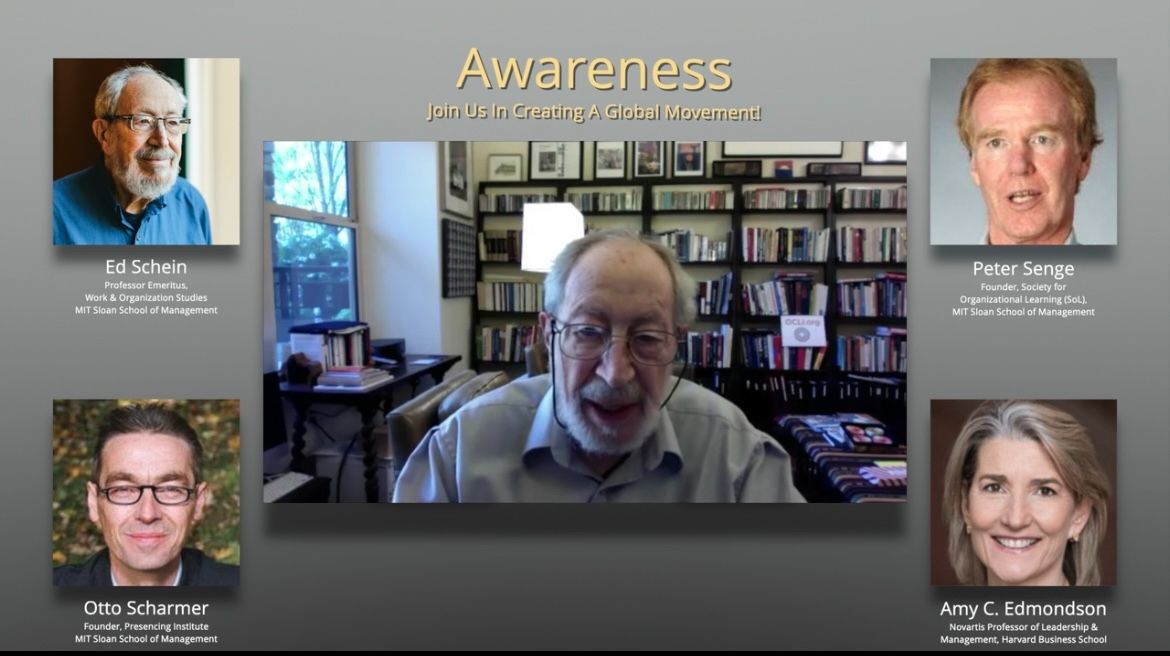
“Creating a Triple A Society through Reflection on Crisis and Change”: Video Sessions with Ed Schein, Amy C. Edmondson, Otto Scharmer, and Peter Senge, Spring 2021 (© G. Fatzer | M. Laederach | D. Schmid)

From Organizations to Ecosystems—The Real Leadership Challenge Ahead

As Peter Senge once emphasized in a joint session with Gerhard Fatzer, Dr. (Visiting faculty and Visiting Prof.), and Mouna Laederach, the decisive arena of the future will not be individual organizations or isolated leadership formats. It It will be the quality of ecosystems.

Markets, clients, partners, and internal stakeholders are becoming ever more interconnected. In this reality, the central leadership challenge is no longer efficiency alone, but the ability to hold the productive tension between competition and collaboration.

Organizations that master this tension are those that invest deliberately in relationships—across boundaries, roles, and institutional logics. The quality of these ecosystems will determine who thrives in the long run:

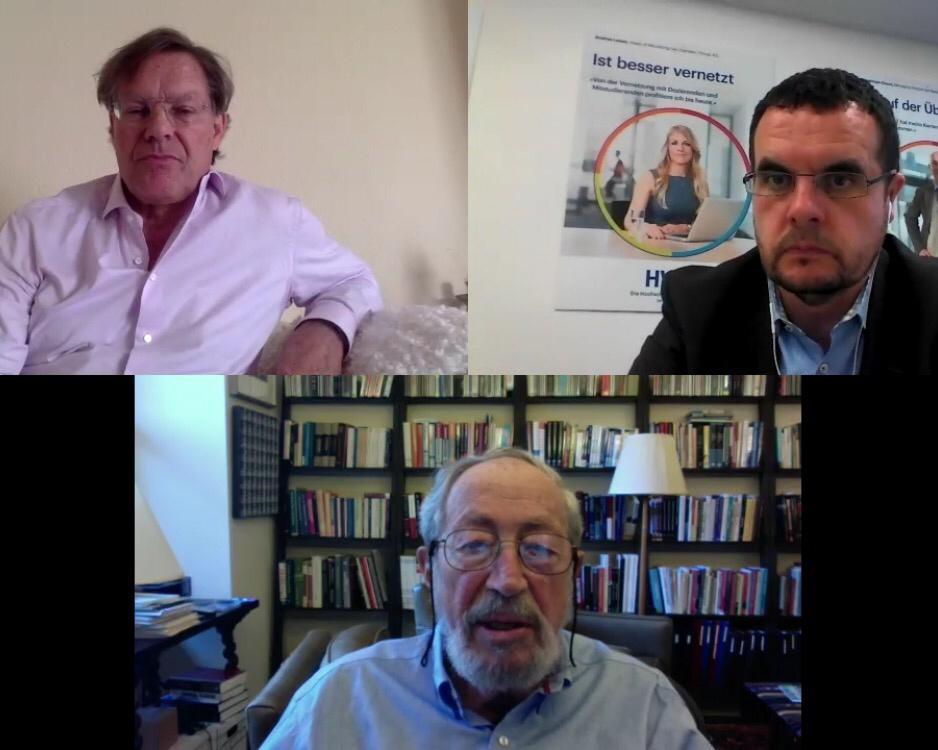
Peter Senge, Video Session, 13/03/2021 (© G. Fatzer | M. Laederach | D. Schmid)

Leadership Remains Relational—Especially in the Age of AI

In Humble Leadership (2nd edition, 2023), Edgar Schein and his son Peter Schein articulate a principle that has guided my own work for decades: complex challenges cannot be solved through authority or expertise alone. They require openness, trust, and genuine curiosity.

Leaders achieve better outcomes when they acknowledge what they do not know, ask honest questions, and listen attentively—thereby unlocking the collective intelligence of the system. Recognized as the number one management thinker in the world for two consecutive years, Amy C. Edmondson captures this insight succinctly in Right Kind of Wrong (2023):

«A system’s results are less shaped by its individual parts than by how the parts relate to one another.» (Amy C. Edmondson)

This is not a «soft» idea. It is a strategic one.

We are entering an era in which artificial intelligence will dramatically optimize processes, decisions, and information flows. Precisely because of this technological acceleration, human connection becomes more—not less—decisive. AI can enhance systems, but only people create meaning, trust, and commitment. Leadership effectiveness, customer loyalty, and long-term business success will therefore depend on the quality of relationships leaders are able to build and sustain.

In his final message, shared by Otto Scharmer in January 2023, Edgar Schein expressed this truth with characteristic clarity—reminding us that progress without relationship ultimately remains hollow:
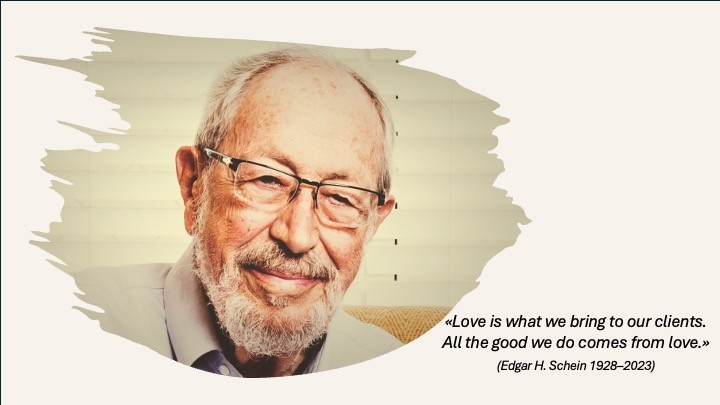
«Love is what we bring to our clients. All the good we do comes from love.» (Edgar H. Schein)

What I Stand For Going Forward

Looking back, there is little to add and much to affirm. What I carry forward from these years is a clear position: sustainable success is never primarily a question of tools, models, or technologies. It is a question of relationship quality—between leaders and teams, organizations and customers, and increasingly, between organizations themselves. This is the principle I continue to stand for. It is the lens through which I approach leadership, collaboration, and long-term customer relationships.

Thank you to everyone who has been part of this journey. It has truly been a pleasure—and it is far from over. The path ahead is guided by a simple conviction: leadership begins with human connection, and organizational success will be shaped by the quality of our relationships. My next learning page will be written soon, so stay tuned: «The Future is analogue!»

Daniel C. Schmid, January 1st, 2026

Working with Ed Schein

Together with Prof. Gerhard Fatzer, PhD, Trias Institute, I had the honor and great pleasure of working for several years with Prof. Edgar H. Schein, Emeritus MIT Sloan School of Management (1928–2023), one of the co-founders of organizational development. On the one hand, I was able to learn a great deal about the fascinating facets of organizational development directly from the spiritus rector of the discipline, and on the other, I was able to catch up on Ed’s exciting family history (see my HWZ/Trias conference keynote in 2017, Learning Journey to Trstena). I have thus succeeded in tracing the history of his ancestors in Trsztena in Upper Hungary and Trstena in Czechoslovakia in detail (see my article A Learning Journey to Trstená According to Edgar H. Schein’s «Organizational Culture Model»). I felt overwhelmed and honored by how Ed had evaluated my research:

«Daniel Schmid has opened up an important new research field—historical ethnography—in tracking down some of my family origins in communities that deliberately hid them because of fears of the Nazi anti-semitism. This was not only of great value to me but revealed some historical details of how a powerful evil ideology can be so threatening that it not only kills existing people but scares communities into wiping out the identities of former residents. This research is an important contribution to both social psychology and political science because we see similar uses of fear mongering in today’s autocratic leaders.» (Edgar H. Schein, 05.03.1928 – 26.01.2023)

Our fruitful cooperation with Ed lasted until 2023 and produced several significant scientific contributions to organizational development, including books, video statements and timeless ideas that Gerhard Fatzer and myself would like to share with you:

From start-ups to mature organizations, all teams and organizations need cultural work. In the age of globalization and digital competition, unprejudiced leadership and cultural development are therefore of central importance. As friends from the circle of Ed Schein, we encourage an international dialogue on the «Art of Change» in the age of digitalization and bring together German and American approaches. The precise descriptions of the fundamentals of sustainable organizational development can be used directly in projects and transformation processes. Here are our results, please help us to preserve Ed Schein’s work for future generations:

2024: Gerhard Fatzer / Anne Fanenbruck (Ed.): Organisationsentwicklung als Kunst. Veränderung durch Dialog und vorurteilslose Führung. Hommage an Edgar H. Schein [Organizational Development as an Art. Change through Dialogue and unprejudiced Leadership. Homage to Edgar H. Schein], Psychosozial-Verlag, Giessen 2024.

2021: Gerhard Fatzer / Daniel C. Schmid (Ed.): Kunst der Veränderung. Vorurteilslose Führung und Organisationsentwicklung [The Art of Change. Humble Leadership and Organizational Development], Psychosozial-Verlag, Giessen 2021.

2020: A Manifesto of the Pioneers of Change, together with Edgar H. Schein, Amy C. EdmondsonC. Otto Scharmer, and Peter M. Senge (based on 4 individual video sessions organized by MounaLife, Gerhard Fatzer, and myself).

2019: Gerhard Fatzer / John van Maanen / Daniel C. Schmid / Wolfgang Weber (Ed.): Edgar H. Schein – The Spirit of Inquiry. innsbruck university press, Innsbruck 2019.

2017: HWZ / Trias Conference «Humble Leadership» with online keynote by Edgar H. Schein (Zurich, 23.05.2017)

2017: Interview Edgar H. Schein: «CEOs sollten dringend demütiger werden» [«CEOs urgently need to become more humble»], HR Today 05/2017.

Together with Ed’s son, Peter A. Schein, co-founder of scheinocli.org, we will carry on Ed’s powerful fire to preserve freedom of thought, as quoted in the 2020 Manifesto of the Pioneers of Change, together with Edgar H. Schein, Amy C. EdmondsonC. Otto Scharmer, and Peter M. Senge. Typical of Ed, he has seen the Covid-19 pandemic as an opportunity to be prepared for future incidents:

«But as social scientists we have been educated to think out-of-the-box, so let’s not abdicate our responsibilities and fail to use some of the skills that we do have, and take advantage, at least to speak up. The coronavirus has provided us an incredible opportunity. If we don’t speak up now, it might be too late when the global warming virus becomes the next global pandemic.»

Coda: For all of you who want to delve deeper into Ed’s seminal work, we highly recommend the following article published by MIT: «Organizational Culture: 5 enduring management ideas from MIT Sloan’s Edgar Schein».

Edgar H. Schein: «The Spirit of Inquiry»

Ed Schein together with his mother, Hildegard, and his father, Marcel Schein, ca. 1936. Photograph courtesy of Edgar H. Schein.

But, what I will most treasure from this extraordinary experience was less the ideas than the complex weave of ideas and personas. (…). I will refrain from continuing to empty the lesson inventory from which they are drawn and end with a simple deep bow and “Thank You” to a genuine teacher.

Peter Senge, Senior Lecturer, Leadership and Sustainability, MIT Sloan School of Management, Cambridge MA; Academy for Systems Change, Norwich Vermont.

This book was put together as a labor of love. The original idea was born by Daniel C. Schmid and Gerhard Fatzer at the 2017 Conference of Trias and at HWZ University of Applied Sciences in Business Administration Zurich. The Spiritus Rector or Master Editor was John Van Maanen with his unique network. The work presents a set of essays cobbled together by friends and colleagues of Edgar H. Schein’s to honor his invigorating and path breaking contributions over six decades to a number of scholarly and applied fields in the social sciences. It is also something of a belated but collective present for Ed on his 90th birthday.

Edgar H. Schein about «Humble Leadership»: Conference of Trias and HWZ University of Applied Sciences in Business Administration Zurich, 23 Mai 2017.

As editors of this work, we asked a set of people who had worked closely with Ed at various stages of his long and continuing career to inscribe what they felt were the lessons they have learned from him as well as what they consider to be his major contributions to their respective fields. We have fifteen essays drawn from a variety of authors, some who emphasize the theoretical and research side of Ed’s work, some who emphasize the developmental and practical side the work, and some who pay attention to both sides since each side informs the other.


Edgar H. Schein – The Spirit of Inquiry
Gerhard Fatzer, John Van Maanen, Daniel C. Schmid, Wolfgang G. Weber (Eds.)
ISBN 978-3-903187-39-9

The fifteen essays could easily have been multiplied many times over for Ed’s spheres of influence and acquaintances are extensive (and still expansive). His influence is not strictly bound by discipline nor geography. His work weaves various threads drawn from psychology, sociology, anthroology and attracts interest from North America to Europe to Asia. We have tried to be representative of Ed’s diverse concerns in selecting contributors to this collection but, of necessity, spare in asking for papers. Not surprisingly, we met with success when soliciting commentary. All the contributors were enthusiastic and eager to write and delivered on a relatively tight editorial schedule.

The contributors are roughly divided – with some overlap – into four groupings: Colleagues, coworkers with Ed, in the Organization Studies Group at MIT and associates of Ed who worked with him at MIT outside the group in the areas of organizational change and development; former students of his in the Organization Studies Group; two contributors who know well Ed’s fascinating family history, including his son; and three long-time friends of Ed from Europe. The essays from each contributor detail areas of admiration and influence that differ slightly from one another but do come together to offer a rather full portrait of Ed’s special and skilled artistry, a blend of the humanities and social sciences.

To briefly introduce the sections of this collection of appreciative writings, the first section has essays by Lotte Bailyn and John Van Maanen, colleagues in the Organization Studies Group, that focus more or less on the scholarly side of Ed’s work and their lengthy shared history at MIT. This section also includes essays by Peter Senge and Otto Scharmer, associates of Ed’s at MIT but members of different groups in the Sloan School. The latter two essays focus on more on Ed’s applied, helping side and deal closely with his role as an exemplary teacher or, as a label Ed might prefer, a respected coach.

Ed Schein, the humble educator, has developed, articulated, honed, and passed on these deeper principles to a global community of action researchers and reflective practitioners. (…) With a deep bow to a teacher who – more than any other teacher I have ever met – embodies every single principle that he espouses in his own actions and way of being.

C. Otto Scharmer, Senior Lecturer, Leadership and Sustainability, MIT Sloan School of Management, Cambridge MA; Presencing Institute, Cambridge, MA.

The second section features six contributions by former students of Ed’s in the Organization Studies Group who have gone on to have rather notable research and teaching careers of their own: Steve Barley, Gibb Dyer, Gideon Kunda, Deborah Dougherty, Nitin Nohria and Jane Salk. All were doctoral students in the 1980s and, while matriculating in different years, were part of what might be thought of now – although at the time unrecognized – as a small but “hot group” which included the faculty as well. It was quite democratic. Everybody, including grad students were in on the act. There were status differences to be sure but all could speak up and partake in debate. Multiple authorship was common. To some degree, those engaged saw the little group as something of an embattled enclave – both within the Sloan School and MIT at large vis-à-vis the prestigious, quantitatively oriented groups – like economics – that dominated the local pecking order and, externally, in contrast to the traditional “organizational behavior” groups at other larger (and regarded as misguided or dumber) institutions.

The third section consists of two selections. The first offers a quick history of the peripatetic but close knit family life Ed experienced when he was young. As told by Daniel C. Schmid, our man from Zurich grew up in several academic environments far from Cambridge, Massachusetts, during the run up to World War II which was, to say the least, an intense and dangerous moment in time. The second selection is a warm and unique depiction of Ed as both a father and an unintentional futurist written by his son and sometimes co-author Peter A. Schein. Both broaden our view of Ed Schein by portraying his life and times beyond the often-cloistered confines of the academy.

The fourth and last section of the volume presents essays written by European friends of Ed Schein: Gerhard Fatzer, Sabina Schoefer, and Wolfgang G. Weber. Gerhard’s essay takes up his original encounters with Ed Schein in the early 1980s at MIT and traces their evolving relationship over the years. Sabine Schoefer, along with Sylvia Boecker and Gerhard Fatzer, was instrumental in introducing Ed Schein to the German speaking public through his translated books and through six Trias Conferences held in Ed’s birthplace of Zurich. Sabine’s essay present what she calls a “vital toolkit for the development of organizations” that draws on many of Ed’s writings. Wolfgang’s contribution is to compare Ed’s work on dialogue and discourse with some prominent European theorists such as Juergen Habermas.

The volume concludes with a selected list of Ed’s publications. A complete listing would have amounted to well over 200 cites so we have made some editorial deletions – cutting out those one-off publications such as compressed interviews, abridged special interest publications, some brief forwards to other works, short reviews, and summaries of previously published works. We have however highlighted – denoted in the manuscript in bold letters – those books Ed himself considers his most vital and meaningful. And, as is apparent from the testimony given here, it is a body of work that has maintained its relevance and usefulness to a multitude of readers over the demanding test of time.

Order the book here: Amazon or innsbruck university press